This page is a plain-English overview written by a contractor, not an attorney, and it isn't affiliated with the Florida DBPR. Rules and fees change. Confirm everything with the official sources linked below before you pay or file.
Step 1: Find out if you even need a state license
Florida only requires a state contractor license for certain work. DBPR lists cabinets, countertops, paint, wallpaper, carpet, tile, and window treatments as examples of work that doesn't need state licensure. Florida law also bars cities and counties from requiring a local license for painting, flooring, cabinetry, handyman services, pressure washing, decorative tile and stone, stuccoing, and several other trades (F.S. 489.117(4)(a)).
Epoxy floor coatings fall under flooring, which Florida doesn't license at the state level and doesn't let local governments license. You still need a local business tax receipt, insurance, and permits wherever the work isn't exempt. If a job turns into structural concrete or slab repair, that part may need a licensed contractor.
The $2,500 minor work exemption
Casual, minor, or inconsequential work where the total contract price is under $2,500 is exempt (F.S. 489.103(9)). It doesn't apply if you split a larger job to stay under the limit, or if you advertise that you're a contractor. Per DBPR guidance, work that needs a building permit typically doesn't qualify.
The 10 steps at a glance
- Decide if you need a state license. Covered above.
- Pick your license. Certified licenses let you work anywhere in Florida. Registered licenses only cover the local areas where you hold a local license.
- Confirm your experience. The most common route is 4 years of experience with at least 1 year as a foreman. Division I licenses have extra project requirements.
- Pass the state exam. Register with Professional Testing, Inc., then schedule with Pearson VUE. The exams are open book and the passing score is 70%.
- Set up the business. Form your LLC on Sunbiz, get your FEIN, and line up general liability insurance and workers' comp or an exemption.
- Get your credit report. You need a FICO score of 660 or higher, or completion of a 14-hour financial responsibility course.
- Get LiveScan fingerprints. Use the construction ORI number so the results reach DBPR.
- Submit your application. Most people use the CILB 6 "qualifying a business" form.
- Handle local setup. Get your business tax receipts, register with building departments, and add the required notices to your contracts.
- Keep it active. Renew every 2 years and complete 14 hours of continuing education.
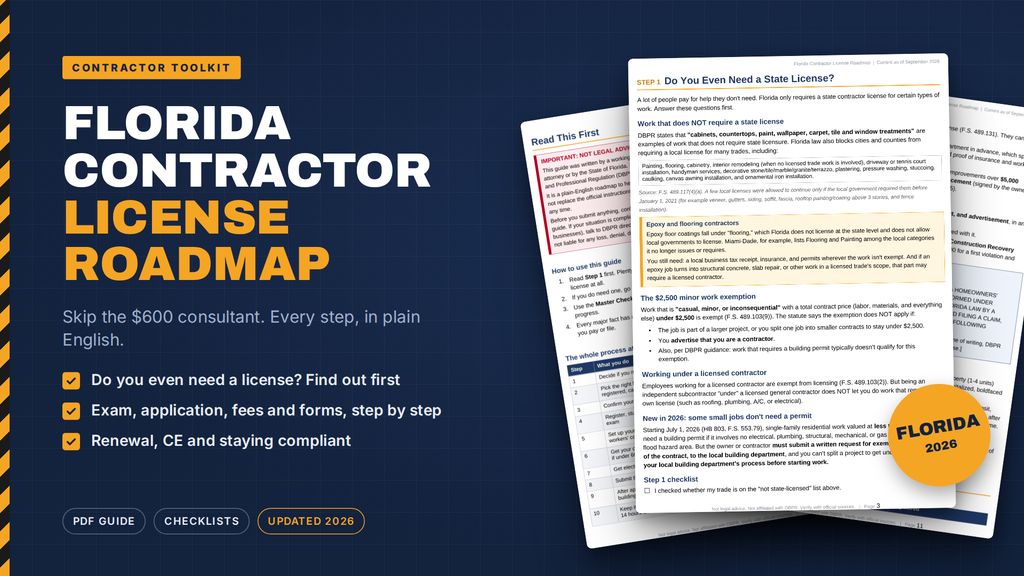
Get the full 15-page roadmap
Every step in detail, which CILB form to use, the credit and fingerprint rules, the mistakes that cause delays, plus a master checklist, cost worksheet, and renewal calendar.
Get the guide ($50)What it costs (state fees)
| Item | Fee |
|---|---|
| PTI exam registration (each time you register) | $135 |
| Business and Finance exam | $80 |
| Contract Administration + Project Management (Division I) | $40 each |
| Trade Knowledge exam (Division II) | $80 |
| Certified license application (depends on when you apply) | $245 or $145 |
| Workers' comp exemption (lasts 2 years) | $50 |
Fees are from DBPR's exam application pack and CILB application forms, current as of September 2026. Books, prep courses, fingerprints, credit reports, and insurance cost extra and vary.
Outdated advice to ignore
- "You need a surety bond if your credit is under 660." The current rule uses a 14-hour financial responsibility course instead.
- "You need a separate business license." DBPR stopped issuing those in 2009. You now apply as the qualifying agent for your business.
- "Your county will license your flooring or painting business." Since July 1, 2025, local governments can only license trades that match state license types.
Get the full 15-page roadmap
Every step in detail, which CILB form to use, the credit and fingerprint rules, the mistakes that cause delays, plus a master checklist, cost worksheet, and renewal calendar.
Get the guide ($50)