- Check your trade first. General, building, residential, roofing, plumbing, HVAC, pool and electrical work need a state license. Painting, flooring, cabinetry, tile and handyman work don't.
- Set up the company: a Florida LLC is $125 on Sunbiz, an EIN is free, and you'll need a local business tax receipt from your county and often your city.
- Sales tax is different for contractors. On most jobs you pay tax on materials and don't charge it to your customer.
- Workers' comp kicks in at one employee in construction. Owners can get a $50 exemption for themselves.
- Florida requires specific notices in residential contracts over $2,500, and has rules on deposits over 10%.
Step 1: Find out if your trade needs a license
This decides everything else, so do it first. Florida licenses construction trades through the Construction Industry Licensing Board (CILB), and electrical work through a separate board (ECLB).
| Usually needs a state license | No state license, and no local license allowed |
|---|---|
| General, building and residential contractors | Painting |
| Roofing | Flooring (including epoxy coatings) |
| Plumbing | Cabinetry |
| HVAC and mechanical | Handyman services |
| Pool and spa | Decorative stone, tile, marble, granite and terrazzo |
| Electrical (ECLB) | Pressure washing, plastering, stuccoing, caulking |
The right-hand column comes from F.S. 489.117(4)(a). It also covers interior remodeling that doesn't include licensed work, driveway and tennis court installation, and canvas awning and ornamental iron installation.
Certified vs. registered: a certified license lets you work anywhere in Florida. A registered license only covers the local area where you hold a competency card. Most new contractors who need a license go for certified.
The $2,500 exemption: small, casual jobs with a total price under $2,500 are exempt (F.S. 489.103(9)). It doesn't apply if the job is part of a bigger project, if you split a job to stay under the limit, or if you advertise yourself as a contractor.
Contracting without a required license is a first-degree misdemeanor for a first offense, and a felony for a repeat offense or during a declared state of emergency. If your work touches structure, roofing, plumbing, electrical or HVAC, check with DBPR before you sell it.
Need a license? Our free Florida contractor license guide walks through the 10 steps, the exams and the fees.
Step 2: Form your company
Most Florida contractors form an LLC. It's cheap, it's fast, and when you run it properly it helps keep business debts away from your personal assets.
- File on Sunbiz. Articles of organization are $100, plus $25 to designate a registered agent, so $125 total. You can be your own registered agent if you have a Florida street address.
- Using a name that isn't your LLC's exact name? Register a fictitious name (DBA) for $50. Florida requires you to advertise the name once in a newspaper in your county before you register it.
- Licensed trades: if you need a state license, the license has to be tied to the business. The CILB process covers qualifying your company.
You can operate under your own name with no state filing. It's simpler, but you and the business are the same in the eyes of the law. Most contractors move to an LLC as soon as they start signing real contracts.
Step 3: EIN and a business bank account
Get an EIN from the IRS. It's free and takes a few minutes online. Never pay a website to get one for you. Then open a separate business checking account and run every job through it. Mixing personal and business money is the fastest way to lose the protection your LLC gives you, and it makes tax time miserable.
Step 4: Local business tax receipt
Florida counties charge a local business tax (F.S. 205), and many cities charge their own on top. You may need both. Apply with your county tax collector and your city if you're inside city limits. If your trade is licensed, expect them to ask for your state license number. Receipts generally renew every year on September 30.
Step 5: Insurance and workers' comp
General liability
Get it before your first paid job. Customers, general contractors and property managers will ask for your certificate of insurance. If you're a licensed contractor, Florida sets minimums (Fla. Admin. Code 61G4-15.003):
| License type | Public liability | Property damage |
|---|---|---|
| General and building contractors | $300,000 | $50,000 |
| Residential and most other CILB categories | $100,000 | $25,000 |
Workers' comp
Florida is strict here. In construction, you need workers' comp with one or more employees (other industries get until four). If you get caught without it, the state can shut your job down with a stop-work order and fine you two times the premium you should have paid, or $1,000, whichever is more.
- Owner exemption: owners can exempt themselves through the Florida Division of Workers' Compensation. It costs $50, is good for two years, and is limited to three officers who each own at least 10% of the company.
- The exemption only covers you. The moment you pay a helper, you need a policy.
- Using subs? Get their certificate of insurance and their workers' comp policy or exemption before day one. If an uninsured sub gets hurt, the claim can come back to you. The Florida Subcontractor Pack has a sub agreement, onboarding checklist and COI request letter.
Step 6: Sales tax and payroll taxes
Sales tax works differently for contractors
Under Florida Rule 12A-1.051, a contractor who improves real property is the end user of the materials. On lump-sum, cost-plus and time-and-materials jobs, you pay sales tax when you buy materials and don't charge sales tax to your customer. Build that tax into your material costs when you price the job.
The exception is a "retail sale plus installation" contract, where you itemize and price the materials before the work starts and charge tax on them. If you work that way, or also sell materials on their own, you'll need to register with the Florida Department of Revenue. Florida's state rate is 6%, plus your county's surtax.
Hiring employees
Once you pay $1,500 or more in wages in a calendar quarter, or have someone on payroll in 20 different weeks of a year, you owe Florida reemployment (unemployment) tax and need to register with the Department of Revenue. Federal payroll taxes start with your first paycheck. A payroll service is worth it from day one.
Every business is different. Have a CPA set up your books, your sales tax approach, and how your LLC is taxed.
Step 7: Contracts, deposits and Florida notices
Get your paperwork ready before your first estimate, not after. Florida has a few rules that catch new contractors off guard.
- Deposits over 10%. On residential jobs, if you take more than 10% of the contract price up front, you have to apply for permits within 30 days and start work within 90 days after the permits are issued, unless there's just cause or a written agreement otherwise (F.S. 489.126).
- Construction lien law disclosure. Direct contracts over $2,500 for work on a 1 to 4 unit home must include Florida's lien law notice, in 12-point bold capital letters, on the first page or a separate page, signed and dated by the owner (F.S. 713.015).
- Recovery Fund notice. If you hold a CILB license, your residential contracts must include the Florida Homeowners' Construction Recovery Fund notice unless the job is $2,500 or less (F.S. 489.1425).
- Change orders in writing. Every scope or price change gets a signed change order before you do the work.
- Lien waivers. Collect them from subs and suppliers when you pay them, and give them to your customer when they pay you.
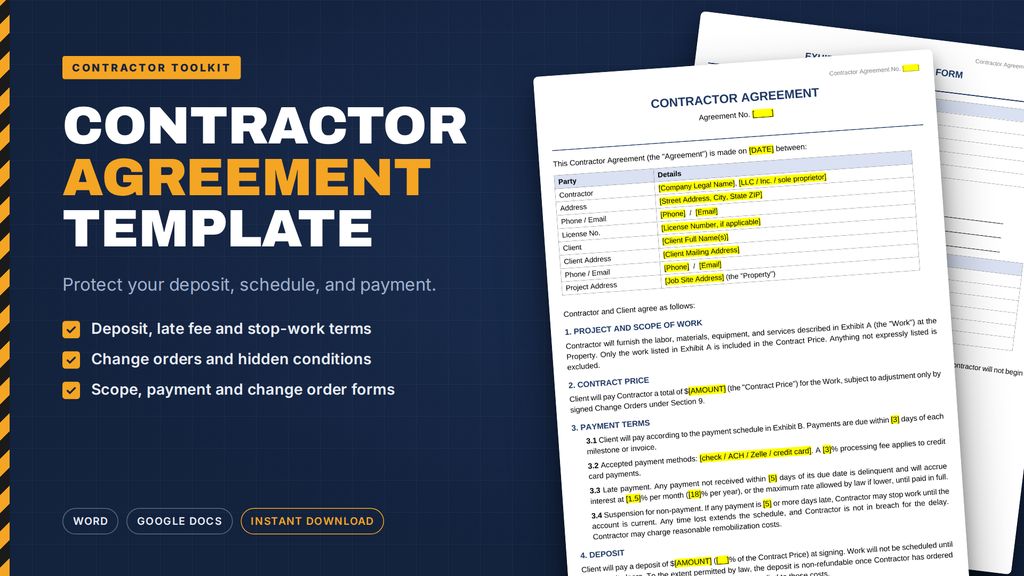
Start with a solid contract
Our Contractor Agreement covers scope, deposits, change orders, payment terms and stopping work for late payment. Edit it in Word and have your attorney review it for your trade.
Get the Agreement ($29)Step 8: Price jobs so you actually make money
Most new contractors don't fail from lack of work. They fail because they're busy and broke. Build every price from your real costs:
Price = (materials + labor + equipment and other costs + overhead) × your markup
- Include the sales tax you pay on materials in your material cost.
- Know your real labor cost, including payroll taxes and workers' comp, not just the hourly wage.
- Markup isn't margin. A 30% markup on cost is only about a 23% margin.
- Set a minimum job price so small jobs still cover your setup and drive time.
Try it on your next job with our free contractor calculators for epoxy, tile, paint, drywall, concrete and decks.
Step 9: Get your first customers
- Google Business Profile. Free, and it's where most homeowners find local contractors. Add photos from every job.
- Reviews from day one. Ask at the final walkthrough, when the customer is happiest. The Google Review Kit has QR cards and word-for-word scripts.
- Before and after photos and short videos on Instagram, Facebook and TikTok.
- Partner with other trades. Realtors, property managers and general contractors all need reliable subs.
- Follow up on every estimate. Most jobs are lost to silence, not price. The Client Scripts pack has follow-up texts you can copy and send.
What it costs to start
State and federal filings are the cheap part. Here's what the paperwork side costs in Florida:
| Item | Cost |
|---|---|
| Florida LLC (articles + registered agent) | $125 |
| LLC annual report (every year) | $138.75 |
| Fictitious name, if you use a DBA | $50 + newspaper ad |
| EIN | Free |
| Local business tax receipt | Varies by county and city |
| Workers' comp owner exemption | $50 (2 years) |
| CILB exam and initial license, if your trade needs one | about $535 + exam prep |
| General liability insurance | Varies by trade and coverage |
State fees from Sunbiz, the Florida Division of Workers' Compensation and Fla. Admin. Code 61G4-12.009, checked October 2026. Fees change, so confirm before you file.
Your real startup budget is tools, a work vehicle, insurance and marketing, and that depends on your trade. For an epoxy example, see how to start an epoxy flooring business.
Deadlines to put on your calendar
| What | When |
|---|---|
| Sunbiz annual report | Between January 1 and May 1 every year. Late fee is $400. |
| Local business tax receipt | Renews yearly, generally by September 30 |
| Workers' comp exemption | Every 2 years |
| CILB license renewal | Every 2 years, with continuing education |
| Insurance policies | Yearly. Send updated certificates to your GCs. |
Miss the annual report long enough and the state dissolves your LLC. Set a reminder for January.
Your first 30 days
- Confirm whether your trade needs a state license
- Form your LLC on Sunbiz and get your free EIN
- Open a business bank account
- Get your county (and city) business tax receipt
- Buy general liability insurance and file your workers' comp exemption
- Talk to a CPA about sales tax and bookkeeping
- Get your contract, change order and lien waiver forms ready
- Set up your Google Business Profile
- Build your prices from your real costs
- Put your annual report and renewal dates on your calendar
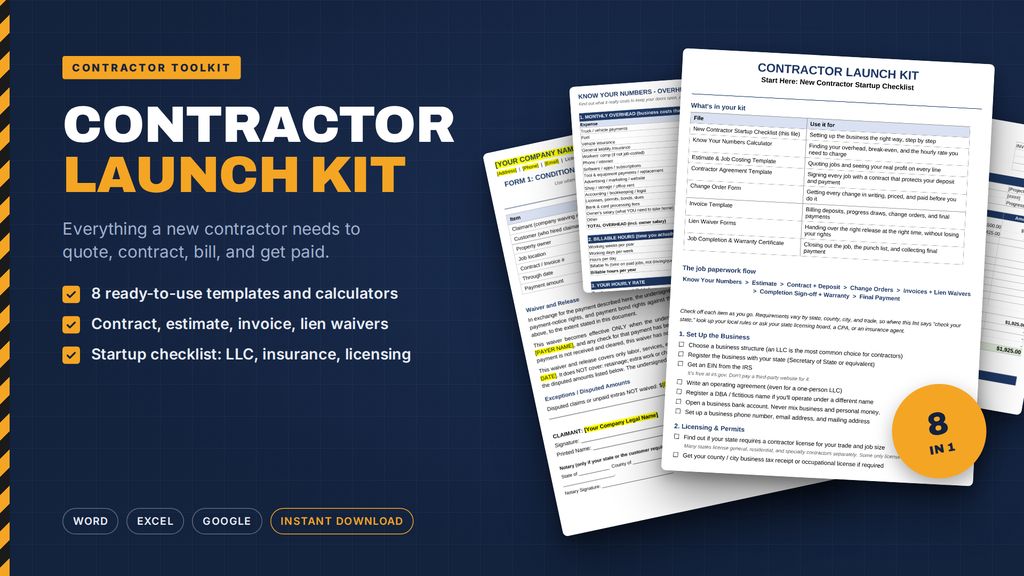
Get the whole setup in one download
The Contractor Launch Kit has a startup checklist, pricing calculator, contract, estimate, change orders, invoices and lien waivers, ready to fill in for your first job.
Get the Launch Kit ($89)Frequently asked questions
How much does it cost to start a contracting business in Florida?
The state filings are cheap. A Florida LLC is $125 to form and $138.75 a year to keep active, and an EIN is free. Most of your startup money goes to tools, a vehicle, insurance and marketing. If your trade needs a state license, budget about $535 in CILB exam and license fees on top of exam prep and study materials.
Do I need a license to start a contracting business in Florida?
It depends on your trade. General, building, residential, roofing, plumbing, HVAC, pool and electrical work need a state license. Florida also bars cities and counties from requiring a local license for painting, flooring, cabinetry, handyman services, pressure washing, decorative tile and stone, plastering, stuccoing, caulking and several other trades (F.S. 489.117(4)(a)). You still need a local business tax receipt and insurance.
Should a Florida contractor form an LLC?
Most do. An LLC costs $125 to form on Sunbiz and helps keep business debts separate from your personal assets when you run it properly, with its own bank account and contracts signed in the company name. It doesn't replace insurance. Ask an accountant how you want it taxed.
Do Florida contractors charge sales tax?
Usually not on the job itself. On lump-sum, cost-plus and time-and-materials contracts for work on real property, Florida treats the contractor as the end user of the materials. You pay sales tax when you buy materials and don't charge your customer sales tax. Retail sale plus installation contracts work differently. See Rule 12A-1.051 and talk to your accountant.
Do I need workers' comp if I work alone in Florida construction?
If you have even one employee in construction, you need workers' comp. Owners can apply for a construction exemption for themselves through the Florida Division of Workers' Compensation. It costs $50, lasts two years, and is limited to three officers who each own at least 10% of the company. The exemption covers you, not your helpers.
How much deposit can a Florida contractor take?
There's no hard cap, but on residential jobs, if you take more than 10% of the contract price, Florida law requires you to apply for permits within 30 days and start work within 90 days after the permits are issued, unless there's just cause or a written agreement otherwise (F.S. 489.126).
Official sources
- Sunbiz (Florida Division of Corporations)
- DBPR Construction Industry Licensing Board
- IRS: Get an EIN
- Florida Department of Revenue: sales tax
- Florida Division of Workers' Compensation
- F.S. 489.117, F.S. 489.126 and F.S. 713.015
This guide is general information from a working contractor, not an attorney, accountant or insurance agent, and it isn't affiliated with any Florida agency. Laws and fees change. Confirm requirements with the official sources above and a licensed professional before you rely on them.